

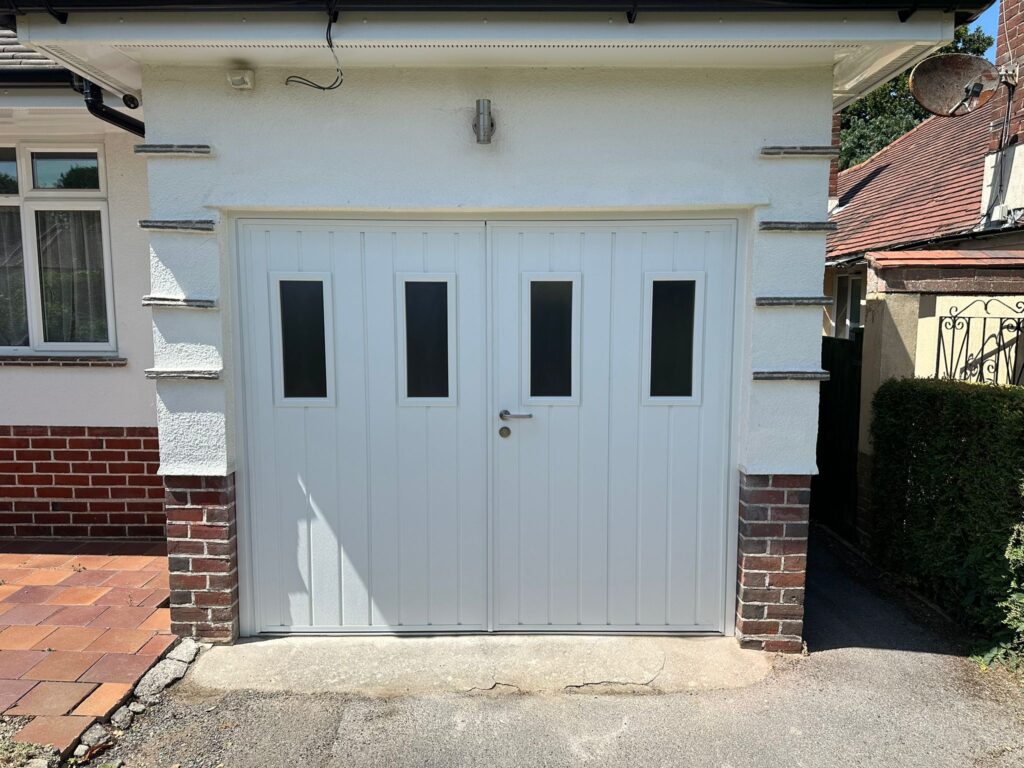
Do you need planning permission to replace a garage door? Not usually, but there are some caveats.
Straightforward like-for-like replacements on standard properties usually fall under permitted development rights, so you can proceed without applying to the council.
However, there are important exceptions, such as listed buildings, conservation areas, Article 4 directions, and situations where the works alter the external appearance of your home.
Read on for a breakdown of when a garage door replacement needs approval and when it doesn’t. Don’t get caught off-hand and land yourself in trouble!
When Garage Doors Fall Under Permitted Development
Permitted development rights allow homeowners to carry out certain works on their property without submitting a planning application.
For garage doors, replacement or repair of an existing door, even in a different style or colour, typically qualifies, provided the property itself is not listed, in a conservation area or subject to an Article 4 direction removing those rights.
The key test is whether the change materially alters the external appearance of the house. Swapping a single-skin steel up-and-over for an insulated sectional door in a similar colour is well within permitted development.
Changing a roller door for a set of traditional side-hinged garage doors in a heritage colour by contrast, might be viewed differently by planners in a sensitive area.
What If the Property Is Listed?
If your home is Grade I, Grade II*, or Grade II listed, permitted development rights don’t typically apply.
Any change to external features requires listed building consent from the local authority, including garage doors that form part of the property.
Listed building consent is a formal process, and altering a listed building without it is a criminal offence.
If your garage door is part of a listed property, speak to your council’s conservation officer before making any changes.
Most conservation officers are open to discussing proposals informally before you commit to a design. It’s easier for everyone if concerns come out early rather than at application stage.
What About Conservation Areas?
Conservation areas cover neighbourhoods of special architectural or historic interest, designated by local authorities under the Planning (Listed Buildings and Conservation Areas) Act 1990.
Living in one doesn’t automatically mean you need planning permission for a garage door, but the rules are tighter.
Replacing a garage door with something visually similar is generally still permitted development within a conservation area.
But if you want to change the style significantly, for example moving from a modern sectional door to a period-style timber-look design or introducing an unusual colour, it’s worth asking the council first.
Some councils have Article 4 directions in specific conservation areas that remove permitted development rights entirely.
Article 4 Directions
Article 4 directions let local authorities remove permitted development rights in a defined area, usually to protect the area’s character in conservation areas or estates with strong architectural cohesion.
Where an Article 4 direction is in place, a planning application is required for changes that would otherwise be automatic.
Councils publish maps showing Article 4 areas online, and it takes a few minutes to check whether yours applies to garage door alterations before you order.
When to Give the Council a Call
The general principles above cover most situations, but a phone call or online enquiry to the local planning department is time well spent in specific cases:
- The property is listed at any grade
- The property is in a conservation area and the new door will look noticeably different from the original
- An Article 4 direction is in place for your street or estate
- The new door will change the size or shape of the opening itself
- The property is a new build under a Section 106 agreement, which may impose additional restrictions
Most councils respond to informal planning enquiries within a couple of weeks. If in doubt, ask. A rejected retrospective application costs far more than a proactive one and most councils would rather advise up front than issue enforcement notices later.
What to Do Before You Buy
At Skandoor, we survey every property in person before quoting. If we spot anything that might trigger planning considerations, we’ll flag it to you.
For most replacements, you’ll be fine. Permitted development covers a wide range of garage door work, and standard like-for-like replacements rarely need paperwork. Knowing where you stand before you order the door just means fewer surprises later.
Request a free survey, and we’ll walk you through the specification, colour, and any planning considerations relevant to your home.
Meta Description: Choosing a garage door for a period property? Guidance on authentic proportions, timber-look materials, side-hinged options and heritage colours.
How to Match a Garage Door to a Period Property
You might find yourself holding on grimly to your old timber garage door long after it’s no longer practical.
It’s fair. A badly done modern replacement can deflate your home’s character and undermine years of careful attention to detail.
Done well, however, a period-appropriate garage door disappears into the frontage while bringing modern insulation, security and mechanisms.
Here’s how to fit a new garage door to a period property.
Material Choices for a Period Look
Wooden garage doors are still available and some listed properties may require them under planning conditions. For most period homeowners though, an insulated steel door with the right proportions, panel detailing and heritage colour delivers an authentic look with far less ongoing maintenance.
At Skandoor, we manufacture our sectional and side-hinged doors from steel, then finish them in-house through powder coating. The colour is bonded to the surface, so it won’t peel, flake or fade the way painted timber can.
Combined with insulated cores and full weather seals, the door delivers thermal performance and long-term appearance that traditional timber can’t match without regular upkeep.
For stone or brick period properties, this combination of steel construction, traditional configuration and heritage colour tends to strike the best balance of authentic appearance and long-term durability.
Side-Hinged Garage Doors: The Period Classic
Side-hinged garage doors are the traditional configuration on most pre-war British properties. Two doors, hinged on either side of the opening, open outwards like a stable pair. Before the up-and-over mechanism became common in the mid-20th century, virtually every garage had them.
For a period property, side-hinged doors carry an authenticity that no other configuration matches. They also allow the driveway to be used while one door remains closed, which is useful on smaller sites, and integrate naturally with pedestrian access through one door.
Modern side-hinged doors offer the visual advantages of the original without the compromises. Insulated cores, weather-sealed frames, and optional electric operation make the traditional configuration fully workable in a modern household.
Heritage Colour Palettes
Colour choice carries more weight on period properties than most. The right shade of green, blue, or red enhances the frontage; the wrong one dominates it.
Popular heritage colours for traditional garage doors include:
- Deep heritage greens, particularly suited to Georgian and early Victorian properties
- Off-blacks with a slight softness compared to modern jet blacks
- Warm reds inspired by Victorian coach doors
- Traditional whites and creams for later Victorian and Edwardian frontages
- Muted greys for properties with painted render frontages
At Skandoor, our in-house powder coating covers the full RAL European and British Standards colour ranges, so matching a specific heritage colour or precisely matching your front door and window trim is straightforward.
Working with Skandoor on Period Properties
We specify traditional garage doors regularly for owners of Victorian, Edwardian, Georgian and rural period properties across the south of England.
Each project starts with a free survey, where we discuss the property’s original features, aesthetic goals and any applicable planning considerations.
For listed properties or homes in conservation areas, we’ll flag anything worth checking with the local council before commissioning the door. Contact us to get started.